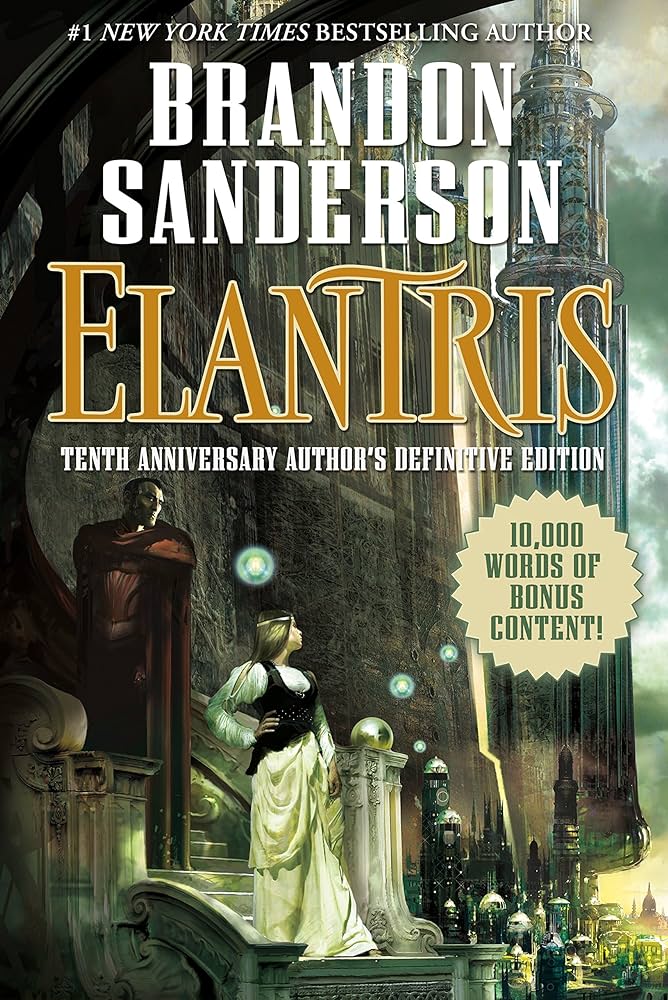
Review: Elantris by Brandon Sanderson

Brandon Sanderson is the current modern face of fantasy, but Elantris wasn’t the book that put him there.
There are brilliant flashes of the author that he would quickly become, but you can feel the weight of the world-building weighing down on him as he tries to balance everything and everyone in this novel – and there is a lot in this novel.
“Hrathen stopped, allowing Fjon – Kae’s Derethi head arteth – to approach.”
Elantris is a standalone story set in the now-expansive Cosmere and feels like a mixture of Game of Thrones with some unique magical influences, maybe similar to the Earthsea novels by Le Guin, in that there’s a lot of political intrigue mixed with a distinctive magical system, all centered around a mystery that will shape the world in which the novel takes place.
The world-building takes center stage as Sanderson introduces us to Sel and the many countries, cities, organizations, and people within it. You can feel Brandon doing his best to smooth out the rough edges of his prose as he feeds information to the reader, but perhaps being overwhelmed at the sheer multitude of information he has to dol out. What comes at times are unarticulate info dumps that just plop information on the reader, who doesn’t know how to handle it in the moment.
“The common people served the arteths and dorven, the arteths and dorven served the gradors, the gradors served the ragnats, the ragnats served the gyorns, the gyorns served Wryn, and Wryn served Jaddath. Only the gragdets – the leaders of the monasteries – weren’t directly in the line.”
What even is this?
Over time, it all begins to make some sense, but by the end of the novel, you’re left with a feeling that there’s much more given than needed, and it comes at a cost.
The heart of the novel revolves around a group of characters: Raoden, a prince stricken with a mysterious, magical disease tied to the core of the story; Serene, a princess who was to marry Raoden but now finds herself in a political maelstrom; and Hrathren, a religious figure who is attempting to convert the area to his religion, Shu-Dereth. On top of that, there is a large group of side characters who help guide the story along but also raise new questions, many of which go unanswered.
All of these characters dance around each other, interacting in various ways, but more often than not, I felt their actions taking a backseat to the world’s story.
The romance between Raoden and Serene didn’t feel believable. They have interactions throughout portions of the novel in which we’re supposed to give way to the notion that they’re falling in love, but it’s not there on paper. We never truly learn who Raoden is as a person, so how can we believe that Serene can love him? The best we learn is that his people loved him and he was a caring prince, unlike his father (another thread not tied up).
Hrathen and his struggles with his underling, Dilaf, are written very well! However, there’s a whole backstory that was only hinted at, which causes a shift in his persona during the last portion of the novel. Learning more about this could have smoothed over some gaps in his character arc.
By the end of Elantris, you can feel the pace of the novel quicken significantly. What were once full chapters, given time to breathe, are now sections within a chapter, dumping information on the reader as Sanderson attempts to wrap up everything and provide a satisfactory conclusion. The pace helps to make everything feel more tense, but we are still getting huge reveals that get lost in the melee.
Sanderson himself will admit Elantris is not his best work, but it’s a fine entry into his mind and the universe that he is creating. Knowing he has written better novels, I would suggest not starting with this one, but if you do, just realize it only goes up from here.
Leave a Reply