
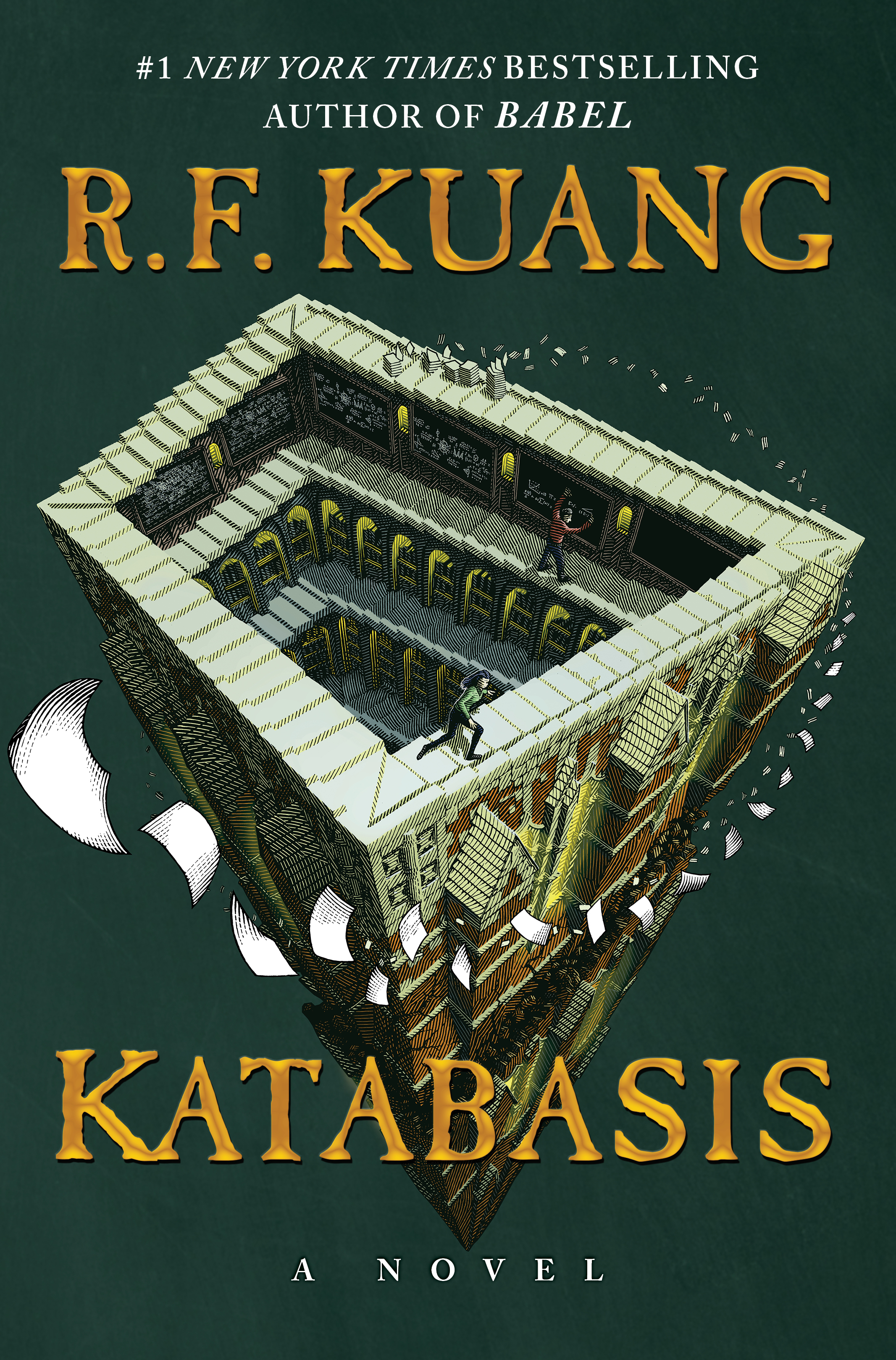
Page Count: 560 Publisher: Harper Collins
Tags: fantasy, hell, magic, r.f. kuang, urban fantasy
• • •
I listened to the audiobook narrated by Morag Sims and Will M. Watt.
I found Katabasis to be an exceptional novel with some of Kuang’s usual flaws, but she manages to overcome those hurdles by crafting a unique and interesting story, albeit one that’s a little too literal at times.
It’s no surprise that R.F. Kuang is a fan of academia and languages. She’s a Marshall Scholar with a Master of Philosophy degree in Chinese Studies, plus multiple paragraphs of other achievements that make most mortals look like they’ve been sitting on their asses doing nothing their whole lives. Her books channel these interests, which is what makes them so unique. Even if they follow standard tropes or don’t fully realize their potential, they take a different path—they have a unique voice that allows them to stand out from the crowd.
Sometimes, I find that it doesn’t work so well. In her much-acclaimed novel, Babel, she created a unique magic system that felt too bogged down in intricacy to be useful, and the constant explanatory shifts on words in different languages often pulled me out of the story, although it was interesting on a different level.
On the flip side, Yellowface felt almost the complete opposite. A commentary on race relations, plagiarism, and the publication industry as a whole, it had fun while delivering its message without requiring you to register for the Kuang Readers Workshop beforehand.
As with any writer’s later work, I found Katabasis to show an evolution in Kuang’s storytelling that includes all the pros of her past work, but still brings forth a few of the cons. On the positive: it’s an entertaining novel that evokes the older adventures into the unknown, such as Jules Verne’s Journey to the Center of the Earth or The Lost World by Sir Arthur Conan Doyle, except our group is descending into hell to find their professor, Jacob Grimes, and bring his soul back to the land of the living. This, of course, is only the tip of the iceberg, as they all have a delicate and sordid history with the professor and each other.
As a novel set in academia, Kuang can go ham on her ideas to varying degrees. The magic system is truly unique, using analytics and paradoxes to rewrite reality, which can at times get confusing, lead to exposition dumps, or slow the story with conversations. Kuang, the nerd she is, often gets lost in her love, but she proudly wears that love on her sleeve. It’s a fun deviation from ‘normal’ magic systems, and I appreciate it.
The story is dripping in analogy and metaphor that feels more personal at times, but these often felt pushed to the surface when they could be subtext, giving the characters and locations more subdued weight. In a book so deep in calculations and wordplay, maybe Kuang didn’t trust the reader enough to make the connections, but it would have added more depth and less bloat to the novel. I do commend Kuang. Some character motivations could have come off as trite, but the author manages to guide us through the situations that define who they are in the story, and emotionally ties us to them.
For such a long story, coming in around 560 pages, with such a huge, otherworldly journey, the stakes and outcome don’t fully live up to the premise. It felt like more of a fun romp, rather than an Odyssey (or Dante’s Inferno) size life-or-death journey. Not everything has to live on that line, but if you’re literally going to hell…
All said, it was a fun read, expertly narrated (unintentionally comical, at times) and full of meat to sink your teeth into. It does get a bit bloated and slow, but if you work your way through it, you’ll find there’s more to love than to banish to hell.
• • •
Never want the journey to end? Take the next step with my monthly newsletter for writing updates, insights, and news on upcoming releases. Plus, get a free, exclusive short story when you sign up!
• • •