
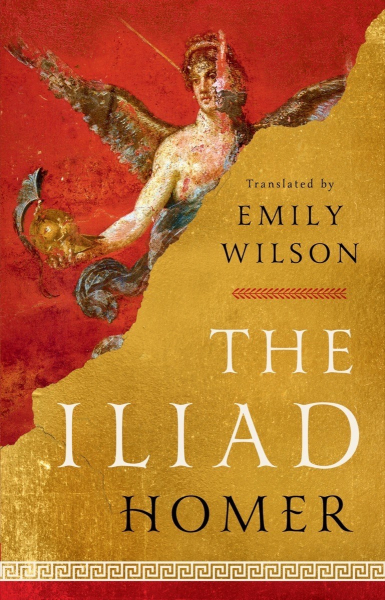
Page Count: 848 Publisher: W.W. Norton & Company
Categories: achilles, emily wilson, fantasy, fiction, hector, homer, odysseus, paris alexander, the iliad, troy
• • •
War. War never changes.
The epic and often convoluted battle between the Greeks and Trojans (and Gods) as the Greeks attempt to rescue Helen, the wife of Menelaus, who was quasi-abducted by Paris after Aphrodite made Helen fall in love with him for his vote in a divine beauty contest–it’s complicated. It truly delves into deeper themes of honor, pride, and the hubris of man. It is a story about the soldiers in the war, probably more than it is about the war itself. It’s also a story about how cruel life can be, petty Gods, spoils of war, women’s limited role in the world, and ultraviolence.
The backbone of the story is Achilles and his anger management issues. Agamemnon took away his spoils of war, and Achilles revolted, giving a profound speech about how none of this is worth a human life, especially if the King was going to go back on his word and take away what they had rightfully earned–the spoils are the only things a soldier has in war aside from each other. Achilles chooses to sit out the war, which has a ripple effect throughout the story as many soldiers lose their lives as a consequence, as well as their eyes, arms, guts, nipples, you name it. It isn’t until Achilles loses a close friend (lover?) in Patroclus that he decides it’s time for him to get back into battle and end this once and for all.
What did I learn from this novel:
- Achilles is an absolute phenomenon of a man and a soldier whom women love, and men would love to be if they aren’t too busy fearing him. He’s a handsome man’s man, and he’s skilled to boot. When he finally enters the battlefield at the end of the novel, even the Gods have a hard time fighting him.
- Speaking of Gods, what a petty bunch of bitches. They fight and lie to each other, and to the humans that make pacts with them. They constantly toil in their lives, even preventing people from dying by simply pushing a spear off course to completely teleporting soldiers from the battlefield. They backstab each other, probably even more than they backstab humans.
- The women in this novel are absolutely shit on. I don’t know if they have Stockholm syndrome, but they cry over the dead men who have abducted them and forced them into slavery, taking them far away from their homes and lives. The female Gods have it best, followed by nobility, but honestly not by much.
- The bonds of brotherhood are strongest of all. I’m a combat veteran, and this novel does a really good job at capturing the full reality of a deployment. It shows everything from these men fighting side by side in the shit to downtime back at camp, creating fun games for morale and to pass the time.
- You could probably track a few family trees reading this novel. At times, it felt like I was reading Numbers or Deuteronomy in the Bible; there were so many names thrown at me.
- Helen is as confusing as most women. I had to Google it while reading because it’s not explained very well, but apparently Aphrodite made Helen fall in love with Paris Alexander as a reward for him voting her the most beautiful of three female Gods. At first, I thought she went over willingly to the Trojans, then wondered if she was trying to get back to Menelaus at one point. She seems to have agency, but, much like the women in my life, her intentions elude me.
- The biggest takeaway from this novel is that there are no good people in this world. The Gods are petty and will do whatever is necessary to make themselves happy in the moment. The Trojans could have ended the war by returning Helen, but they would rather wage a decades-long war. The same could be said about the Greeks, in some sense, but I give them props for not leaving a woman to be abducted.
- The novel doesn’t detail the beginning or the end of the war.
I went into the novel thinking it would be strictly about war, and it is, but as stated earlier, it’s also about Achilles, his destructive anger, and how that affects everyone around him. It leads to the death of many, including his most beloved brother, Patroclus. In the last book of the novel, Achilles shares a truly human moment with King Priam when Hector’s body is finally returned to him. They grieve together. It is a story about healing. It’s a story about how your toxic nature can cause more damage than good, so check that shit at the door. It’s kind of hard to take seriously when the players are still capturing slaves and taking women as trophies, but in a world of trifling Gods, take what you can get.
• • •
Never want the journey to end? Take the next step with my monthly newsletter for writing updates, insights, and news on upcoming releases. Plus, get a free, exclusive short story when you sign up!
• • •