
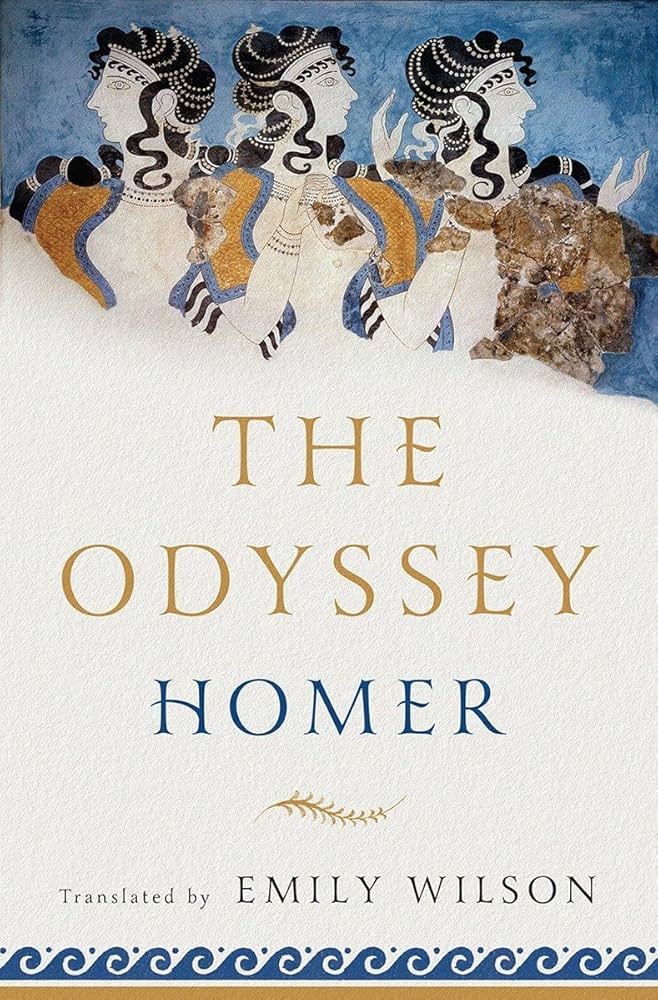
Page Count: 582 Publisher: W.W. Norton & Company
Categories: emily wilson, epic, fantasy, fiction, homer, poem
• • •
If The Iliad was a story of soldiers on the battlefield, The Odyssey is a story of a soldier coming home.
“Tell me about a complicated man.
Muse, tell me how he wandered and was lost…”
The Odyssey is a soldier’s journey to find himself as he struggles to find his way back to his former life, but like most things in life, it’s complicated. After giving his life to a great ten-year Trojan War in which he did unspeakable acts and watched many of his friends die, Odysseus was finally granted the right to go back home to his family and old life. Unfortunately, he was lost after a storm tore his ship apart, killing his crew.
Emily Wilson does an interesting thing in book 9. After learning about Odysseus in stories from his companions and the Gods, we finally learn about Odysseus through his own words. However, where other translators label him a “great teller of tales”, “great tactician”, and “of many wiles”; Wilson calls him the “lord of lies”. At first, this comes off as more than harsh, but as he continues to tell his tale of what happened to him since his shipwreck, we start to wonder if she isn’t far off from the truth.
We see many wild things in The Iliad, but the experiences that Odysseus talks about in this novel heavily delve into the mythological. Did they happen? Maybe. But he could just as easily be making it all up. In the context of this story, in book 9, Odysseus is on the spot being asked by a King in front of his village to talk about what has happened to him since that fateful day, it wouldn’t be unheard of. Every soldier knows, civilians will never understand the horrors he has been subjected to, nor should they. Soldiers do the dirty work so others can keep their hands clean. Odysseus knows he needs to shield them from the harsh truths, so he tells a tall tale about being abducted by a Goddess that loved him, trapped in a giant’s cave and his meal, the greed of his fellow man, and petty Gods that would rather see him dead.
He fights a war overseas, only to find his greatest fight is within himself. That is, until the war comes home.
Yes, I say all this because I am a combat veteran, and this novel hits close to home in many ways, even though it was written almost 3,000 years ago. But I also say all this because a lot of the discourse right now is focusing on the casting of a black actor to play Helen of Troy in the upcoming movie–a woman whose was born from a bird egg after her mother was wooed by the God Zeus who had taken the form of a majestic swan. But the color of her skin is unrealistic.
There are more important storylines to focus on in this great novel.
• • •
Never want the journey to end? Take the next step with my monthly newsletter for writing updates, insights, and news on upcoming releases. Plus, get a free, exclusive short story when you sign up!
• • •